Tessellated Pavement, Tasmania

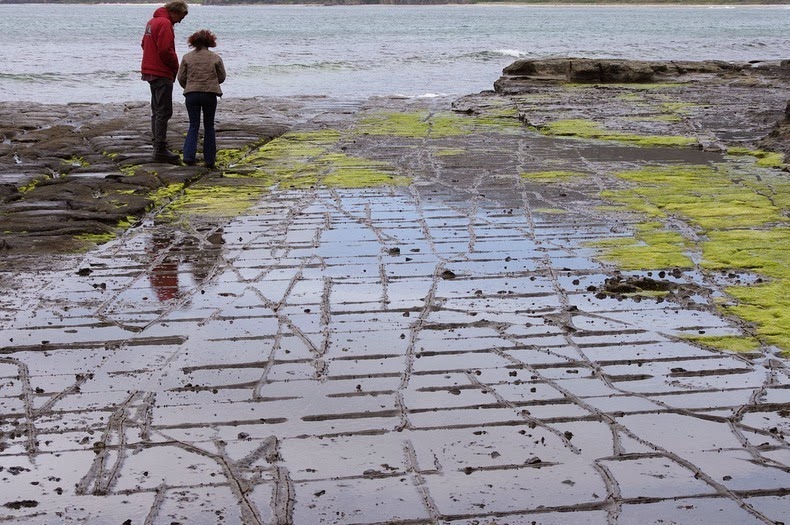
The narrow isthmus connecting the Tasman Peninsula to mainland Tasmania (in Australia) is covered with beautiful and rugged terrain and several unusual geological formations, among which is a peculiar erosional feature called Tessellated Pavement. This rare feature that occurs on an area of flat rock on Eaglehawk Neck looks distinctly manmade, but is in fact, formed by natural causes.

Tessellated Pavement is so called because the rocks here have fractured into polygonal blocks that appears tessellated or tiled. The flatness of the pavement is due to initial erosion by waves carrying sand and gravel, or by chemical action by sea water. The rocks which absorb sea water during high tide dry out during low tide causing salt crystals to grow and disintegrate the rocks - a process which produces shallow basins.


At Eaglehawk Neck two types of formations are seen: a pan formation and a loaf formation.

The pan formation is a series of concave depressions in the rock that typically forms beyond the edge of the seashore. This part of the pavement dries out more at low tide than the portion abutting the seashore, allowing salt crystals to develop further; the surface of the "pans" therefore erodes more quickly than the joints, resulting in increasing concavity.

The loaf formations occur on the parts of the pavement closer to the seashore, which are immersed in water for longer periods of time. These parts of the pavement do not dry out so much, reducing the level of salt crystallisation. Water, carrying abrasive sand, is typically channelled through the joints, causing them to erode faster than the rest of the pavement, leaving loaf-like structures protruding.




Source
READ MORE»

Mystery Object Spotted on Google Moon

Speculation has exploded over these controversial images which appear to show something unexplained on the surface of the moon. The triangular anomaly, spotted on Google’s map of the moon, has rows of seven light-like dots along its edge that have been likened to an alien base or spaceship.

This triangular anomaly with rows of seven light-like dots along its edge has been tracked down on the Google Moon viewer


The two-sided, triangular feature on the lunar surface, was uncovered by paranormal researcher WowForReeel and posted in a new video.

It can be found on the Google Moon viewer at coordinates 22042’38.46N and 142034’44.52E.

‘Is is just a weird looking crater? or is it something else?,’ he asks.

‘It is really there, not faked and I have no clue what it is. I found nothing else like it in any of the other craters.’


This triangular anomaly with rows of seven light-like dots along its edge has been tracked down on the Google Moon viewer

According to website Tech and Gadget News: ‘The gigantic shape actually looks like the leading edge of an immense, triangular space ship, similar to, so far, super secret stealth aircraft technology, but is much larger than any airplane ever built on Earth.

‘The regularly spaced, circular promontory shapes which make up the seven points on the perfectly formed triangle wedge seem to be intelligently designed.


The two-sided, triangular feature on the lunar surface, was uncovered paranormal researcher WowForReeel. 
It can be found on the Google Moon viewer at coordinates 22042'38.46N and 142034'44.52E

‘To date, no other feature has ever been discovered which matches this shape on the moon, or any other planet observed by satellite or exploratory rover.

‘The anomaly is so huge, it’s possible it is some sort of moon base used as a facility for storing and launching alien UFO spacecraft.’

The same YouTube user also claims to have found a similar mystery structure on Earth, nestled under the ice in Antarctica.

‘It is also a triangular shape, measuring 125 by 90 metres. ‘It is unique in the area,’ he said.


Source
READ MORE»

Dinosaur Footprints at Broome, Australia

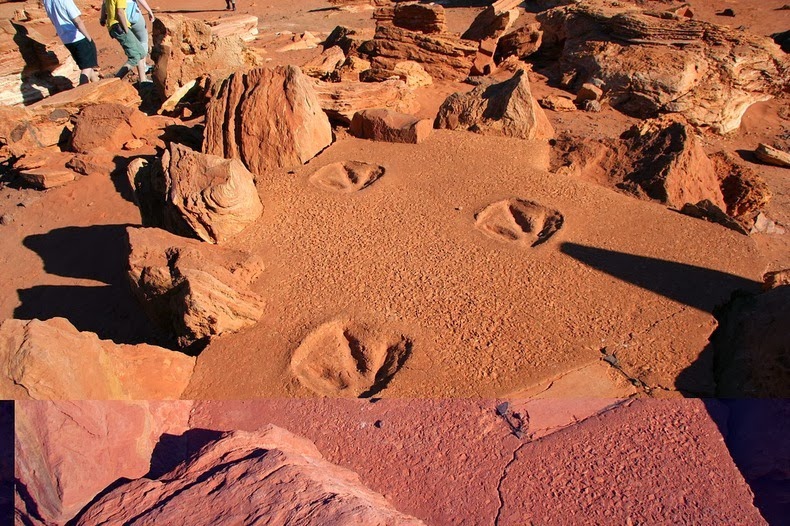
At the southern end of Cable Beach, approximately 6 kilometers from the town of Broome in Western Australia is Gantheaume Point, a scenic area of red sandstone cliffs where one can observe footprints of dinosaurs that once roamed in this area. The fossilized footprints are located on the flat rocks 30 meters out to the sea and can only be seen at low tide. The tracks are 130 million years old and extend in patches for 80 kilometers along the coast. There are walk trails down to the flat sandstone rocks on which the footprints are preserved. A couple of plaster casts have been made of the original prints and embedded into the rocks at the top of the cliff for anyone who visits at high tide, or if you don’t want to walk on the slippery reef, which can get dangerous.


Plaster casts of dinosaur footprints at Gantheaume Point.

During the Cretaceous period, Broome was a massive river delta rich with dinosaur life. At least nine species of dinosaur footprints have been identified at Gantheaume Point. The tracks found in the area prove that all the main groups of dinosaurs inhabited Australia. There are tracks of meat-eaters related to the famous Tyrannosaurus, armoured ankylosaurs, vegetarian ornithopods and stegosaurus, and the immense sauropod which left behind a print measuring 1.7 meters across.

At Gantheaume Point you can see good examples of three-toed theropod prints and enormous round sauropod prints.


Source
READ MORE»

Kamil Crater- Meteor Crater Discovered With Google Earth

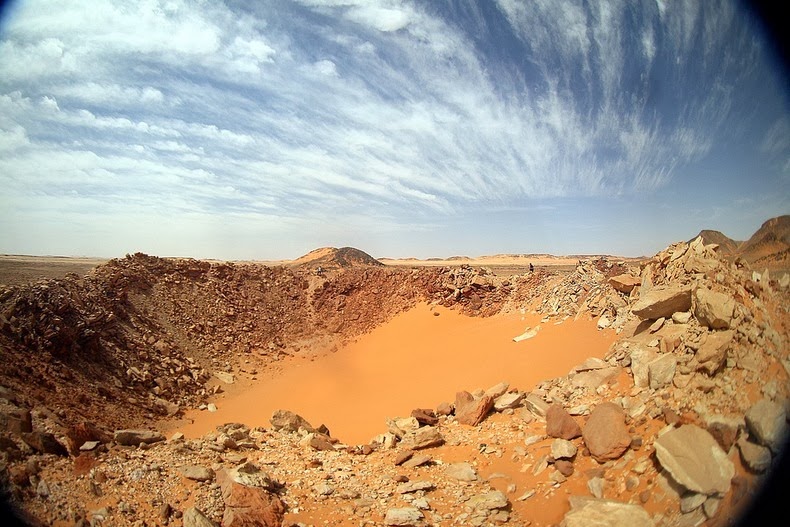
In 2008, a team of researchers sifting through images captured by satellites and available for viewing through the Google Earth program discovered what happens to be one of the best-preserved, and among the youngest impact craters on earth. Later, an expedition reached the site deep in the Egyptian desert to collect iron debris and determine the crater's age and origins. The impact crater was named after the Gebel Kamil mountain, some 65 kilometers from the crater.

The Kamil crater is about 147 feet wide and 52 feet deep, and based on thousands of pieces of space rock that were collected from the surrounding desert, it’s estimated that the crater was created by a solid iron meteor about 4 feet wide and weighting between 5,000 to 10,000 kilograms. It slammed into the desert at speeds exceeding 3.5 kilometers a second, some 5,000 years ago.


One feature that makes this crater unique is the rayed structure that is visible around the crater. These are ejecta rays formed when the meteorite exploded leaving prominent splatter pattern around the blast site. While such ejecta rays are common on Moon or planets with a thin atmosphere, hey are exceedingly rare on Earth because erosion and other geological processes quickly erase such evidence.

It is possible Kamil Crater is the only impact crater on earth to have ejecta rays.


Source
READ MORE»

The magnetic termite mounds, Australia

In Australia's Northern Territory, inside the protected Litchfield National Park, near the township of Batchelor, about 100 kilometers southwest of Darwin, termites build peculiar mounds that are mysteriously aligned to the earth’s magnetic field. Wide swathe of empty ground are filled with hundreds of termite mounds that look like tombstones from a distance, but much larger. The magnetic termite mounds rise to as much as three meters in height, look relatively flat and they all face the same direction with their thinner edges facing the north and south like the needle of a compass.


The currently accepted hypothesis is that the precise alignment allows the termites to keep their homes comfortable. Northern Australia gets extremely hot during the day and cool at night, and researchers believe termites have somehow harnessed the power of the earth’s magnetism to strategically climate-control their homes.

Graham Brown, a former curator of insects at the Northern Territory Museum explains that these towering mounds are essentially termite apartment buildings. A single nest may contain tens of thousands of termites. To comfortably house all those insects, the mound needs to have just the right architecture. He says all the little rooms, or galleries, need the proper moisture level and a good internal temperature, and the north-south alignment of the mounds seems to help keep the termites comfortable.


Source
READ MORE»