Cerne Abbas Giant

The Rude Man of Cerne, better known as the Cerne Abbas Giant, is a giant figure of a naked man with an inappropriately erect phallus, wielding a primitive club in his right hand, made on a hill near the village of Cerne Abbas in Dorset, England. The Cerne Abbas Giant was created by carving through the turf of the hillside to a depth of approximately 30cm to reveal the underlying chalk common in this region. Measuring 55 meters in length and 50.5 meters wide, if measured from hand to hand, it is one of the largest and the most popular hillfigures in Britain. The remarkable phallus alone, including its testicles, is 11 meters long and nearly the length of its head. The Giant has been cheekily described as "Britain's most famous phallus". According to one publication, postcards of the Giant were the only indecent photographs that could be sent through the English Post Office.


Although the Cerne Abbas Giant is often thought of as an ancient creation, its history cannot be traced back further than the late 17th century. The earliest known written reference to the giant appear in a 4 November 1694 entry in the Churchwardens' Accounts from St Mary's Church in Cerne Abbas. Later references to the giant started appearing in contemporary magazines beginning in 1763.

It has been suggested that the figure originally held a cloak in its left arm and stood over a disembodied head. The cloak may have been a depiction of an animal skin, giving credence to the theory that the giant was a depiction of a hunter, or alternatively, Hercules with the skin of the Nemean lion over his arm. Additionally, reviewing historical depictions of the giant, it has been suggested that the Giant's current large erection is, in fact, the result of merging a circle representing his navel with a smaller penis during a re-cut. The lack of earlier descriptions leads modern scholars to conclude that the Giant is no older than the 17th century, and perhaps originated as political satire.

Regardless of its age, the Cerne Abbas Giant has become an important part of local culture and folklore, which often associates it with fertility. Local women who wanted to conceive would spend a night alone on the hillside, particularly within the confines of his giant phallus, and young couples would make love on the giant to ensure conception. Locals would erect a maypole on the earthwork, around which childless couples would dance to promote fertility. Sleeping on the giant was also thought to be a good way to ensure a future wedding for unmarried women.

In modern times the giant has been used for several publicity stunts and as an advertisement to promote condoms, jeans and bicycles, among numerous other things.




Source
READ MORE»

Grass Covered Tram Tracks

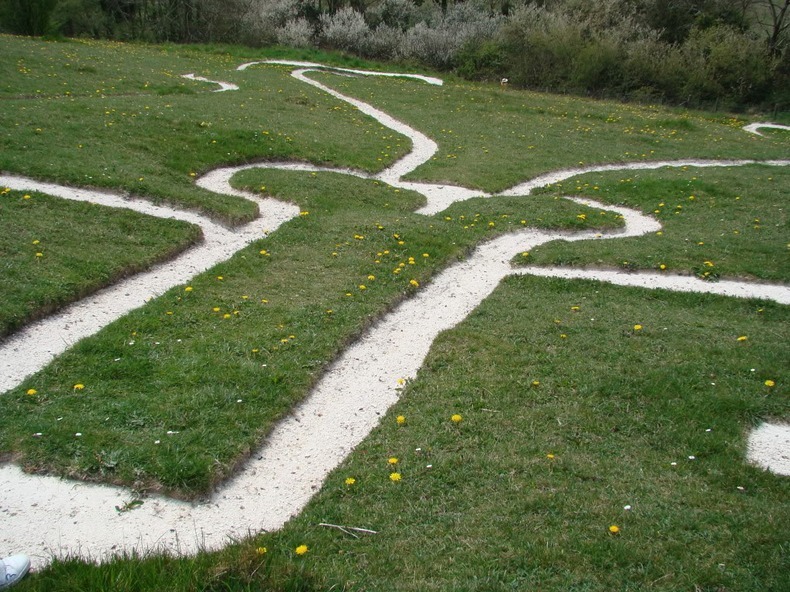
Tram tracks on many European cities are lined with grass, a practice that probably started in the 1980’s to bring greenery back to city space and at the same time, provide habitable zone for numerous insects and invertebrates. These swaths of green provide a host of benefits to any urban area, like reduce urban heat island effect, provide a permeable surface for storm water to infiltrate, reduce pollution and absorb noise generated by the grinding of metal wheels on metal tracks. Not to mention, they look incredibly good in comparison to concrete or asphalt.

Green tracks have become increasingly popular in Europe and can be seen in pretty much every major European cities from Barcelona to Frankfurt, Milan, St-Etienne and Strasbourg.


Source
READ MORE»

Rub al-Khali

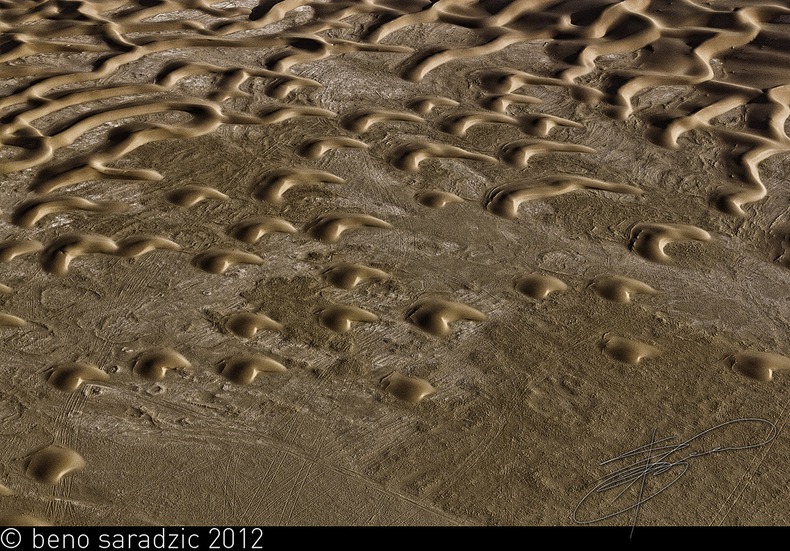
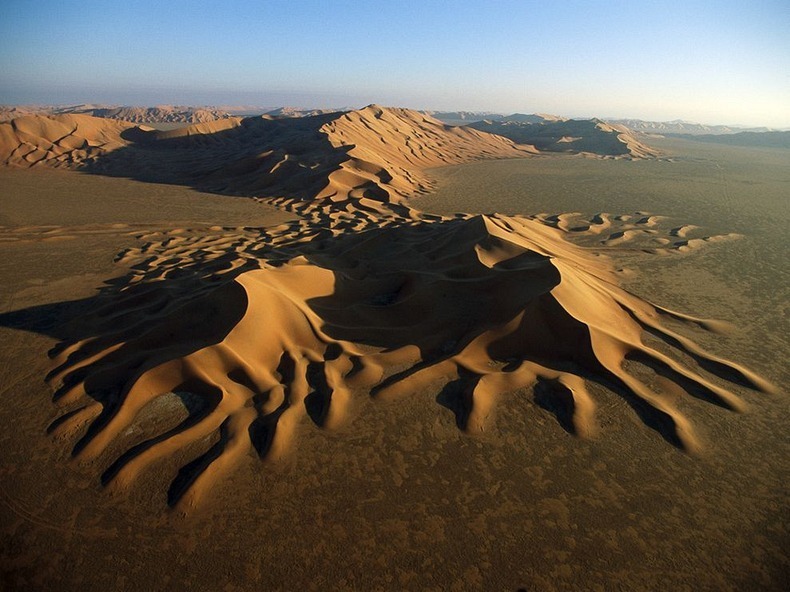
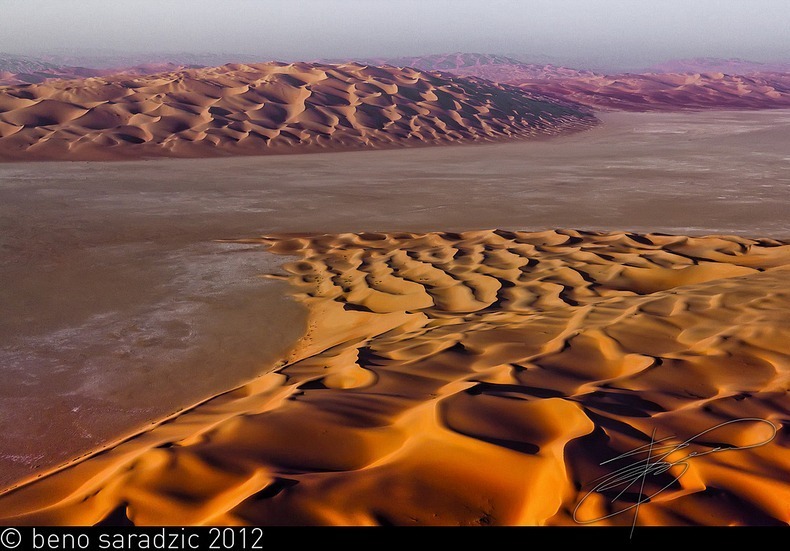
RubĘż al-Khali, (literally “Empty Quarter” in Arabic), also spelled Al-RabĘż al-Khali, is a vast desert in the southern Arabian Peninsula, covering about 250,000 square miles (650,000 square km) in a structural basin that takes in a substantial portions of Saudi Arabia, as well as parts of Oman, Yemen, and the United Arab Emirates. It is the largest area of continuous sand in the world. It holds roughly half as much sand as the Sahara, which is 15 times the Empty Quarter's size but composed mostly of graveled plains and rocky outcrops.

The desert is 1,000 kilometres long, and about 500 kilometres, and its topography is varied. In the west the elevation is as high as 2,000 feet (610 metres) and the sand is fine and soft, while in the east the elevation drops to 600 feet (183 metres) with sand dunes, salt flats, and sand sheets. The terrain is covered with sand dunes with heights up to 250 metres (820 ft), interspersed with gravel and gypsum plains.


Aerial image of the sand dunes of Rub' al Khali


The image above was taken on May 16, 2011, by the crew of the International Space Station. Parallel rows of salmon-pink and white alternate to create a rippling pattern. White salt flats, known as sebkhas or sabkhas, separate the dunes. These salt-encrusted plains vary in hardness, in some places creating a surface strong enough to drive a vehicle over, in other places disappearing into sand.

The orientation of the linear dunes lies at a right angle to northwesterly trade winds that originate in Iraq, known as the Shamal winds. Secondary barchan (crescent-shaped) dunes and star dunes—with crests originating from a single point and stretching in several directions—can form atop the linear dunes when southwesterly winds blow during the monsoon season (Kharif winds). The long, linear dunes begin to break up into isolated large star dunes to the northeast and east (image right). This is likely the result of wind pattern interactions and of changes in the sand supply. (via NASA)

The Empty Quarter was so named because the hyper arid climate and difficulty of travel through the dunes has long discouraged permanent settlement within the region. The first documented journeys made by Westerners were those of Bertram Thomas in 1931 and St. John Philby in 1932. With daytime temperatures reaching 55 degrees Celsius, and dunes taller than 330 meters, the desert may be one of the most forbidding places on Earth.

There is however, evidence of human activity at Rub' al Khali dating from 3,000 to 2,000 years ago, including chipped flint tools, but no actual human remains have been found. Several fossil remains of animals such as hippopotamus, water buffalo, and long-horned cattle also indicates the presence of water once in the distant past.


Source
READ MORE»

Most Damaging Invasive Species in U.S.

Animal invaders have bridged oceanic gaps for centuries—some stowed away in ship-ballast water while others were intentionally lugged over by the overzealous, either to solve a pre-existing problem or just for aesthetic pleasure. However, sometimes a seemingly benign introduction creates environmental travesty and ecosystem despair. Here are the most damaging animals ever to enter U.S. soil.


Constrictors
Big constrictors squeeze the life out of mammalian prey and ecosystems. The U.S. Geological Survey says nine species of pythons, a type of snake that can range from 12 to 28 feet in length, pose a medium- to high-risk threat to ecosystem health. Over the past 30 years, these weighty reptiles have been traded domestically and internationally, and pet owners often take these snakes into homes that cannot accommodate them as they grow. When the snakes get too big, offending owners release them into the typically Floridian wild, where they ingest endangered species like the Key Largo wood rat and invade wildlife refuges. Under the Lacey Act, the U.S. Fish and Wildlife Service proposed to stop constrictor serpent imports into the country and even ban transport between states.


Asian Carp
Many injurious invasives come by water. Asian carp—including the common, black and bighead variety—were brought to the U.S. in the 1970s as live vacuum cleaners meant to remove algae and suspended matter from ponds. These fish can grow to 100 pounds and will eat just about anything, adapting shockingly well to new environments. They have taken over and now represent 90 percent of the biomass in the Illinois River. Researchers worry that these ravenous, opportunistic fish will reach the Great Lakes and cause real problems to the fragile ecosystem—virtually eliminating biodiversity.


Zebra Mussels
Zebra mussels originally smuggled their way into the U.S. in the ballast water of boats and have clogged the inside of pipes since the 1980s. These are no minor pipe blockages—these clogs total billions of dollars in fixes. And the mussels cling to more than pipes. They adhere to motors and to other native mussels, wreaking havoc for boat owners and decimating indigenous wildlife. So many zebra mussels exist in the Great Lakes, constantly filtering water, that they've changed the water from murky to clear, fiddling with the careful ecosystem balance. With clearer water, more sunlight reaches the bottom of the lakes where organisms thrive on darkness and can't live in the light.


Mongoose
The small Indian mongoose, reaching no more than a foot or two in height, was originally brought to Puerto Rico and the Hawaiian islands to protect sugar cane fields from rat and snake damage. But instead of acting as an aid for crowd control, the mongoose quickly became a hindrance, harming far more wildlife than anticipated. Now fully settled in Hawaii, the agile creature preys on birds and small reptiles, which injures both the poultry industry and game hunters and costs the island nations $50 million dollars in damages a year. The mongoose has so far caused the extinction of 12 reptile and amphibian species from Puerto Rico, the West Indies and Jamaica.


Starlings
This innocuous, petite speckled migrant came to the U.S. in the late 1800s as part of a misguided attempt to introduce the animals mentioned in Shakespeare's works to America. Like Shakespeare's works, European starlings stuck in the U.S. and disseminated outward from New York City, where they originally arrived. Now starlings occupy most of North America, steal nesting sites from other birds and rob the agriculture industry of $800 million dollars annually by damaging fields. To make matters worse, starlings spread diseases that infect both humans and livestock, costing a further $800 million a year in healthcare.


Source
READ MORE»

The Winners of Amateur Underwater Photography Contest

Each spring, the University of Miami’s Rosenstiel School of Marine and Atmospheric Science organizes an underwater photography contest open to amateur photographers who earn no more than 20 percent of their income from photography. Started in 2005, the contest has grown in popularity drawing entrants from across the globe. This year over 700 entries were submitted from participants located in 23 countries.

Photographs are judged in five separate categories: Fish or Marine Animal Portrait, Macro, Wide Angle, Student, and Best Overall. The winning images are announced at one of the Rosenstiel School’s Sea Secrets lectures and are displayed in a traveling exhibit throughout the South Florida community.

The following photo by Kyle McBurnie, from California, own this year’s contest. The beautiful beastie is a harbor seal (Phoca vitulina) in a kelp forest at Cortes Bank, about 100 miles west of San Diego, California.


Fan Favorite
Pietro Cremone, Italy
Mating Mandarin dragonets (Synchiropus splendidus) photographed in Puerto Galera, Philippines.


Macro 1st Place
Beth Watson, Missouri
An anemone shrimp in Puerto Galera, Philippines.


Macro 2nd Place
Douglas Good, Pennsylvania
An emperor shrimp (Periclimenes imperator) on two nudibranches (Risbecia tryoni) at Dinah's Beach, Papua New Guinea.


Macro 3rd Place
Frederica Bambi, Italy
A porcelain crab (Neopetrolisthes maculatus) on an anemone at Pescador Island, Cebu, Philippines.


Wide-angle 1st Place
Alex Tattersall, United Kingdom
A lionfish on the Thistlegorm wreck in the Red Sea, Egypt.


Wide-angle 2nd Place
Joseph Tepper, New York
Spinner dolphins (Stenella longirostris) in a small inlet off the Kona coast, Hawaii.


Wide-angle 3rd Place
Pietro Cremone, Italy
Raccoon butterfly fish and angelfish on a reef in the Red Sea, near Sharm el Sheik, Egypt.


Fish or Marine Animal Portrait 1st Place
Steven Kovacs, Florida
A juvenile lionfish during a night dive in Roatan, Honduras.


Fish or Marine Animal Portrait
2nd Place

Marcello DiFrancesco, Italy
The greater blue-ringed octopus (Hapalochlaena lunulata)near Malapascua island, Philippines.


Fish or Marine Animal Portrait
3rd Place
Judy Townsend, Florida
A male Dusky Jawfish with his clutch of eggs at the Blue Heron Bridge in Riviera Beach, Florida.


Best Student Entry
Laura Rock, Florida
Goliath grouper (Epinephelus itajara) during the annual spawning event in Jupiter, FL.


Student 2nd Place
Laura Rock, Florida
Great hammerhead (Sphyrna mokarran) in Bimini, Bahamas.


Student 3rd Place
Austin Gallagher, Florida
Oceanic white tip shark (Carcharhinus longimanus) near Cat Island, Bahamas.


Source
READ MORE»