The Mingun Pahtodawgyi or Minigun Paya in the town of Mingun, approximately 10 km northwest of Mandalay in central Myanmar, is a massive unfinished monument on the banks of the Irrawaddy river. The monument began construction in 1790 by King Bodawpaya, but had to be stopped before it could be completed. Had the monument been finished, it would have been the world’s biggest stupa. Even with just the bottom third of it complete, the unfinished pagoda is a mighty brick edifice, about 50 meters tall and 70 meters wide.
The Mingun Pahtodawgyi is an impressive sight. At the center of the 50 meter high pagoda facing the river is a huge richly decorated entrance. Inside it is a small shrine with a Buddha image. In front of the pagoda facing the river are the remains of two giant lion statues about 29 meters high, guarding the temple.

The door to Mingun Pahtodawgyi.
A stairway to the right of the structure takes visitors to the top of the pagoda from where one can have a commanding view of the area with the nearby Hsinbyume Pagoda, several other pagodas, the Irrawaddy river and the mountains to the back of the pagoda. Access to the stairs, however, is currently restricted after an earthquake in 2012 caused damage to the stupa.
The Mingun Pahtodawgyi was also damaged during a large earthquake in 1838. Several large cracks developed in the structure and the heads of the giant lion statues broke off and rolled into the Irrawaddy river.
Construction of the massive pagoda was ordered by King Bodawpaya, the 6th King of the Konbaung dynasty. King Bodawpaya had acquired a sacred Buddha tooth relic as a gift from a Chinese delegation that visited the King’s court. To enshrine a Buddha relic of such great importance, the King wanted to build the largest pagoda in the country and probably in the world. The King intended the pagoda to be 152 meters high. The impressive scale of the Paya also meant to serve as a demonstration of his power.
The building of the pagoda was such an important project for the King that he left the matters of state to his son and had a new residence for himself built on an island in the river to oversee the construction project.

Bodawpaya used thousands of prisoners of war from his expansionist campaigns and slaves working on the construction of the stupa, and in seven years the pagoda had reached a height of 50 meters, or one third of the intended height. Because of the massive size of the stupa, the heavy burden of building it had fallen upon the people of the kingdom and the state and there was too much dissatisfaction among them. Taking advantage of the King’s superstitious nature, a prophecy was allegedly created, in order to stop the project. The prophecy went that as soon as the pagoda was finished the Kingdom would come to an end.
Some historians speculate that there might have been other causes, such as technical difficulties, insufficient labor and lack of funds that prevented the King from completing the stupa. When the King died in 1819 the project was indefinitely halted and none of his successors resumed work on it.
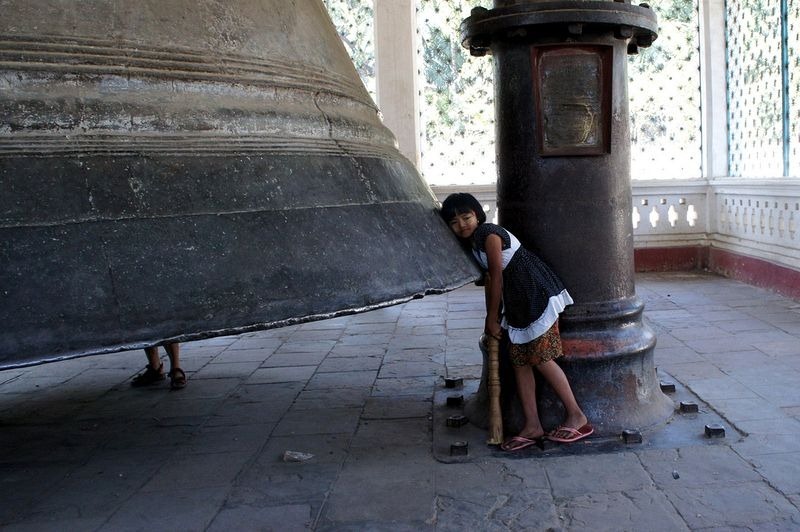
King Bodawpaya probably had high hopes that the stupa would be completed, because in 1808, he had an enormous bell made that was meant to be installed at the top of the giant stupa. It was the world’s largest ringing bell for nearly two centuries until it was eclipsed in 2000 by the 116-ton Bell of Good Luck at the Foquan Temple, in China.
The Mingun Bell is 12 feet (3.66 meters) tall and 16 feet (5 meters) in diameter, and weighted 90 tons. The bell is housed in an intricate Burmese style pavilion a short walk from the Paya. Standing on the river bank near the pagoda is another smaller Pondaw Pagoda, which is a scale model of the original Mingun Pahtodawgyi yielding a clear idea of what the great stupa would have looked like had it been completed.





Pon Daw Pagoda situated near Mingun Pagoda is the 15 feet-tall model of completed model of Mingun Pagoda.

The Mingun Bell.

The Mingun Bell in 1873.

Inside the bell.
Source
READ MORE»
The Mingun Pahtodawgyi is an impressive sight. At the center of the 50 meter high pagoda facing the river is a huge richly decorated entrance. Inside it is a small shrine with a Buddha image. In front of the pagoda facing the river are the remains of two giant lion statues about 29 meters high, guarding the temple.
The door to Mingun Pahtodawgyi.
A stairway to the right of the structure takes visitors to the top of the pagoda from where one can have a commanding view of the area with the nearby Hsinbyume Pagoda, several other pagodas, the Irrawaddy river and the mountains to the back of the pagoda. Access to the stairs, however, is currently restricted after an earthquake in 2012 caused damage to the stupa.
The Mingun Pahtodawgyi was also damaged during a large earthquake in 1838. Several large cracks developed in the structure and the heads of the giant lion statues broke off and rolled into the Irrawaddy river.
Construction of the massive pagoda was ordered by King Bodawpaya, the 6th King of the Konbaung dynasty. King Bodawpaya had acquired a sacred Buddha tooth relic as a gift from a Chinese delegation that visited the King’s court. To enshrine a Buddha relic of such great importance, the King wanted to build the largest pagoda in the country and probably in the world. The King intended the pagoda to be 152 meters high. The impressive scale of the Paya also meant to serve as a demonstration of his power.
The building of the pagoda was such an important project for the King that he left the matters of state to his son and had a new residence for himself built on an island in the river to oversee the construction project.
Bodawpaya used thousands of prisoners of war from his expansionist campaigns and slaves working on the construction of the stupa, and in seven years the pagoda had reached a height of 50 meters, or one third of the intended height. Because of the massive size of the stupa, the heavy burden of building it had fallen upon the people of the kingdom and the state and there was too much dissatisfaction among them. Taking advantage of the King’s superstitious nature, a prophecy was allegedly created, in order to stop the project. The prophecy went that as soon as the pagoda was finished the Kingdom would come to an end.
Some historians speculate that there might have been other causes, such as technical difficulties, insufficient labor and lack of funds that prevented the King from completing the stupa. When the King died in 1819 the project was indefinitely halted and none of his successors resumed work on it.
King Bodawpaya probably had high hopes that the stupa would be completed, because in 1808, he had an enormous bell made that was meant to be installed at the top of the giant stupa. It was the world’s largest ringing bell for nearly two centuries until it was eclipsed in 2000 by the 116-ton Bell of Good Luck at the Foquan Temple, in China.
The Mingun Bell is 12 feet (3.66 meters) tall and 16 feet (5 meters) in diameter, and weighted 90 tons. The bell is housed in an intricate Burmese style pavilion a short walk from the Paya. Standing on the river bank near the pagoda is another smaller Pondaw Pagoda, which is a scale model of the original Mingun Pahtodawgyi yielding a clear idea of what the great stupa would have looked like had it been completed.
Pon Daw Pagoda situated near Mingun Pagoda is the 15 feet-tall model of completed model of Mingun Pagoda.
The Mingun Bell.
The Mingun Bell in 1873.
Inside the bell.
Source