Wolfe Creek Crater in Australia

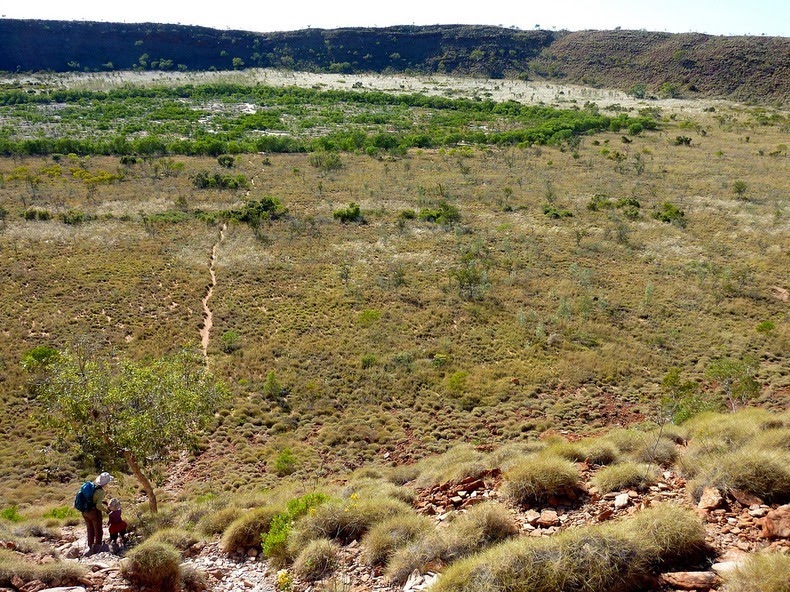
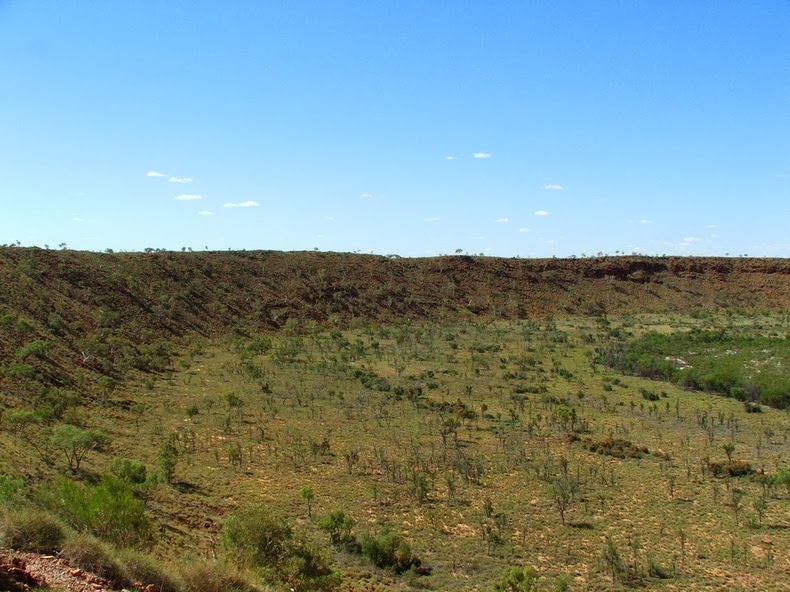
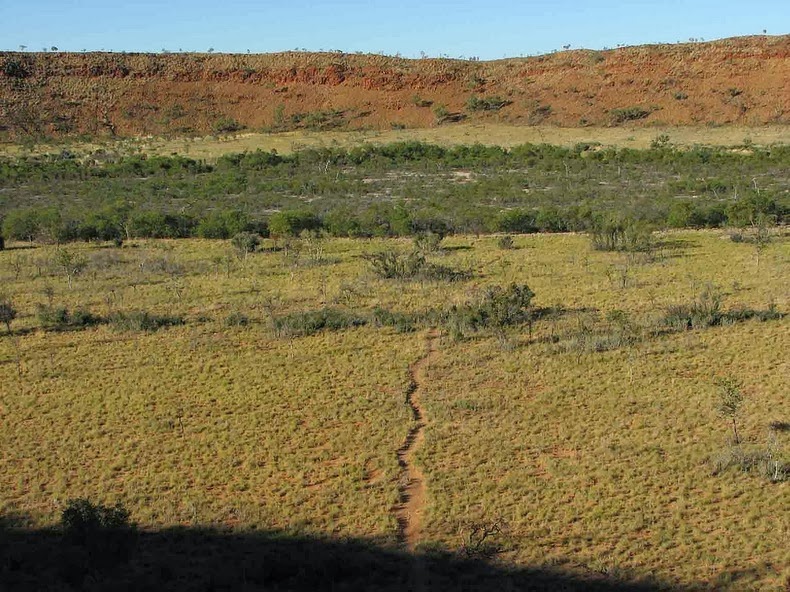
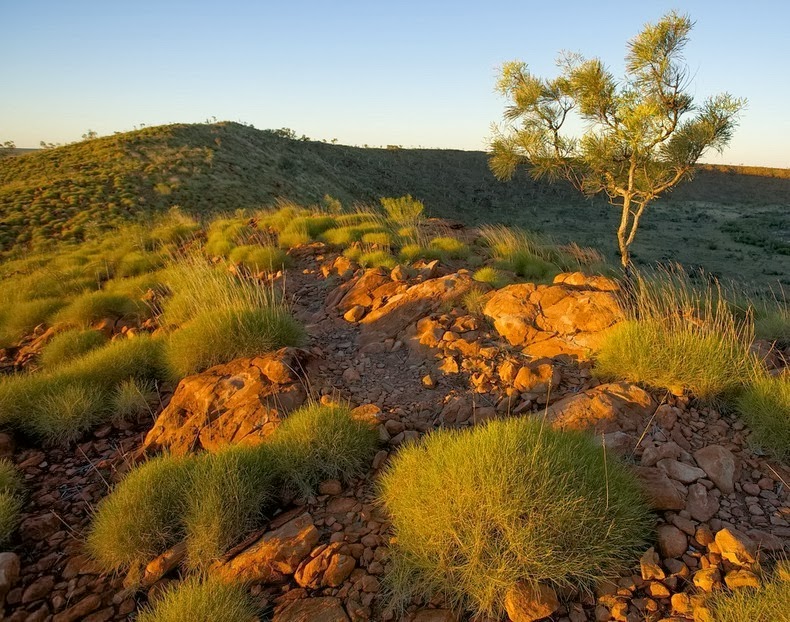
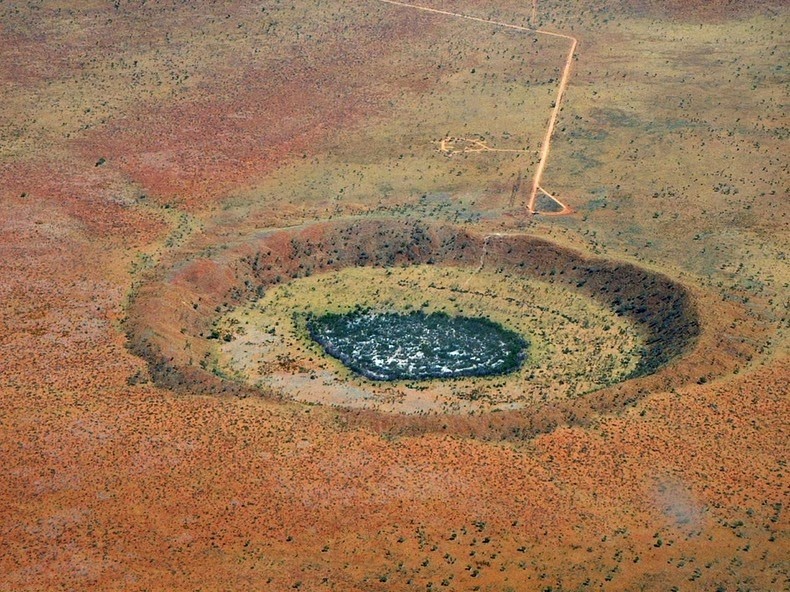
Wolfe Creek Crater is a well-preserved meteorite impact crater located in the flat plains of the northeastern edge of the Great Sandy Desert in Western Australia, some 150 km south of the town of Halls Creek. The crater is considered the second largest in the world from which meteorite fragments have been collected, after the famous Barringer Crater in Arizona. Because of its excellent preservation, the crater clearly shows the classic features that result from a large meteorite striking the Earth.

Wolfe Creek Crater measures roughly 880 meters in diameter, and the mostly flat crater floor sits some 55 meters below the crater rim and some 25 meters below the sand plain outside of the crater. At the crater’s center, the ground rises slightly. Here grows some surprisingly large trees that draw moisture from the crater’s water reserves that remain after summer rains.


The crater was formed 300,000 years ago when a meteorite weighing more than 50,000 metric tons struck the Earth at an estimated 15 kilometers per second. The impact punctured a hole on the surface and shattered rocks well below the ground surface, and the intense heat of the impact liquefied both the meteorite and the nearby terrestrial rocks. These rocks now take the form of rusted balls of iron-shale that occur in the vicinity. These balls can weigh as much as 250 kilograms apiece.

The Wolfe Creek Crater had been known for long by Australia’s Aboriginal people before it was identified by aerial survey in 1947. The locals refer to the crater as “Gandimalal” and it is prominent in art from the region. The European name for the crater comes from a nearby creek, which was in turn named after Robert Wolfe, a prospector and storekeeper during the gold rush that established the town of Halls Creek.






Source
READ MORE»

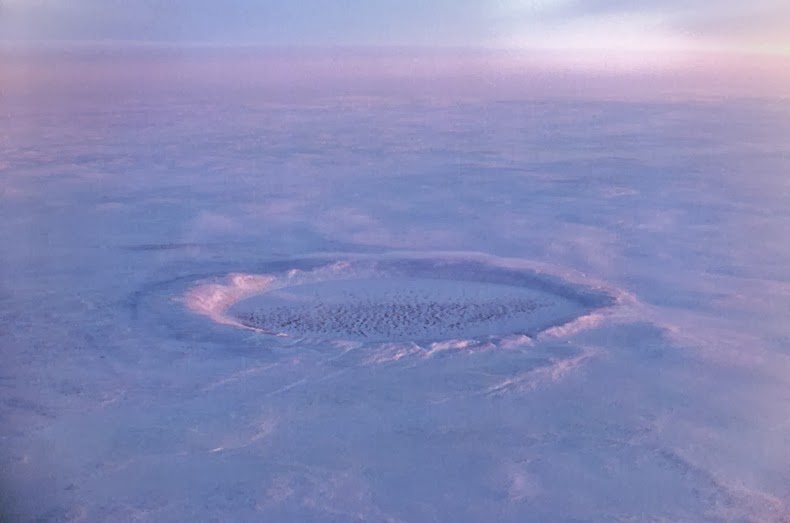
Pingualuit Impact Crater, Canada

In the far north of Quebec, a province in Canada, lies an exceptional natural wonder – a circular lake of blue waters confined within the walls of an ancient but well-preserved meteorite crater. Largely unknown to the outside world, the lake-filled crater had long been known to local Inuit who knew it as the "Crystal Eye of Nunavik" for its clear water. The lake was first observed by the crew of a United States Army Air Force plane in June 1943, who used the lake’s unusual shape and color for navigation, but pictures of it weren’t made public until 1950.

When Ontario diamond prospector Frederick W. Chubb saw the photographs, he became interested in it. He hoped that this might be an extinct volcano and there was a possibility to find diamonds nearby. Chubb sought the opinion of geologist V. Ben Meen of the Royal Ontario Museum, who immediately saw the possibility of an impact crater. Meen organized an expedition to this remote area together with Chubb. It was on this trip that Meen proposed the name "Chubb Crater". Meen organized two more expeditions to the crater, and from the data collected from the site, concluded that the structure was a meteorite crater produced from an impact roughly 1.4 million years ago.


The name of the lake was later changed to "New Quebec Crater" at the request of the Quebec Geographic Board. In 1999, the name was again changed, to "Pingualuit". The crater and the surrounding area are now part of Pingualuit National Park.

Pingualuit crater is 3.44 km in diameter. The crater rises 160 meters above the surrounding tundra and is 400 meters deep. A 267 meters deep body of water fills the depression, forming one of the deepest lakes in North America. The lake also holds some of the purest fresh water in the world, with a salinity level of less than 3 ppm. The lake has no inlets or apparent outlets, so the water accumulates solely from rain and snow and is only lost through evaporation. It is also one of most transparent lakes in the world with visibilities up to 35 meters.


Source
READ MORE»

Kalavantin Durg (Prabalgad Fort), India

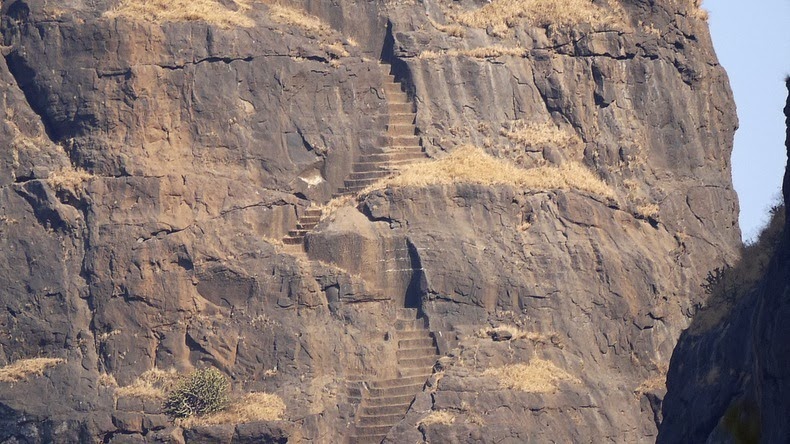
Prabalgad Fort, also known as Kalavantin Durg (Kalavantin’s Fort), is located between Matheran and Panvel in the Indian state of Maharashtra, at an elevation of 2,300 feet in the Western Ghats. It was built at the pinnacle of a rocky plateau very close to Matheran. Previously, the fort was known as Muranjan until it was taken over and renamed by the Maratha forces under Shivaji's rule.

The fort can be approached via a chillingly steep climb. The steps leading up to the fort were cut into the rock of the hill. There are no safety rails on the edge and no ropes on the wall to grab on to. The hardest part is the descent, especially if you have vertigo.


According to legend the fort was built for a queen named Kalavantin but that really seems to be all that anybody knows. Around 1458 Malik Ahmad, the prime minister of the kingdom of Ahmednagar, took over the fort during his conquest of Konkan. The Mughals took control of Prabalgad along with Kalyan, Mahuli, Karnala and a number of other forts after Sambhaji's death.

The fort was conquered by Shivaji from the Mughals in 1657, after he establishing himself in the Kalyan-Bhivandi area. At the time of the attack the fort was governed by Kesar Singh, a Mughal sardar, and was the only fort to put up a strong resistance. On seeing the signs of defeat the women in the fort performed Jauhar, a tradition of self immolation to ensure an honorable and respectful death. Singh died during the battle in October 1657, Shivaji in an act of kindness allowed Singh's mother and her grandchild a safe passage out.


Source
READ MORE»

Fruit that Produces the World’s Most Intense Natural Color

The tiny, rock-hard fruits of Pollia condensata, a wild plant that grows in the forests of Ethiopia, Mozambique, Tanzania and other African countries, can’t be eaten raw, cooked or turned into a beverage. In Western Uganda and elsewhere, though, the plant’s small metallic fruits have long been used for decorative purposes because of an unusual property: They stay a vibrant blue color for years or even decades after they’ve been picked. A specimen at the Kew Botanical Gardens in London that was gathered in Ghana in 1974 still retains its iridescent hue.


Pollia condensata, native to Africa, uses nanoscale-sized structures to produce the most intense color ever studied in biological tissue.

Intrigued, a team of researchers from Kew, the University of Cambridge and the Smithsonian Natural History Museum decided to look into how this plant produces such a dazzling and persistent color. When they attempted to extract a pigment to study, though, they were surprised to discover the fruit had none.

When they examined P. condensata on a cellular level, they realized that the fruit produces its characteristic color through structural coloration, a radically different phenomenon that is well-documented in the animal kingdom but virtually unknown in plants. They determined that the fruit’s tissue is more intensely colored than any previously studied biological tissue—reflecting 30 percent of light, as compared to a silver mirror, making it more intense than even the renowned color of a Morpho butterfly’s wings. Their findings were revealed in a new study published 9 September 2012 in the Proceedings of the National Academy of Sciences.

The vast majority of colors in the biological world are produced by pigments—compounds produced by a living organism that selectively absorb certain wavelengths of light, so that they appear to be the color of whichever wavelengths they reflect. For example, most plants are green because of the pigment chlorophyll, used in photosynthesis, which absorbs most wavelengths of visible light except green, reflecting that color into our eyes. As a consequence, plant colors created by pigmentation appear to be the exact same hue no matter which angle we view them from, and the color degrades when the plant dies.

P. condensata, however, produces its vibrant blue via tiny, nanoscale-size cellulose strands that are stacked inside its skin. These strands are arranged in layers of twisting, arced helix shapes, which interact with each other to scatter light and produce the fruit’s deep blue coloration. Here’s a view of the fruit through an electron microscope, revealing the presence of the color on a cellular level:


The plant’s deep blue hue is produced on a cellular level.

These strands also give the plant an even more fascinating quality, something that can (unfortunately) only be appreciated in person: Depending on how you hold the fruit and from what angle you view it, each of its skin cells actually appears to change color. This is because the distance between the stacked nanoscale fibers varies from cell to cell, so each cell produces a slightly different hue, reflecting light either to the left or right, depending on your vantage point. This accounts for its striking, pixellated appearance:


Each skin cell produces a slightly different color, leading to the fruit’s pixellated effect.

The reason the fruit’s color lasts so remarkably long, it turns out, is because its color is built into its structure, rather than relying on pigments that can degrade over time. Researchers have reported seeing vibrant blue fruits hanging on dried-up, dead P. condensata stems in the field.

The research team also took a stab at explaining why the plant would go to such trouble to evolve a striking color—deception. By imitating the appearance of a juicy, nutritious plant, the color can trick birds and animals into eating the fruit, thereby widely dispersing the seeds inside when they defecate.

Although using animals for dispersal is a strategy common to many plants, most are forced to devote precious calories to produce a sweet, fleshy pulp. P. condensata, however, is able to spread its seeds simply by showing its true colors.


Source
READ MORE»

Krishna's Butterball in Mahabalipuram

Krishna’s Butterball is a curious tourist attraction in Mahabalipuram, a town about 60 km south of Chennai famous for its stone carvings. The “butterball” is a giant balancing rock, 5 meters in diameter, perched on a smooth slope, seemingly defying all laws of physics.

In Hindu mythology Lord Krishna had an insatiable appetite for butter, and as a child, would often sneak a handful from his mother’s butter jar. Situated on a hill slope near the Ganesh Ratha this massive natural rock boulder is attributed to a bolus of butter the young Krishna would steal.


The rock’s awkward position makes it quite popular with locals and tourists alike as it makes for an interesting backdrop for some whacky photographs. It’s a common sight to see visitors placing hands under the stone posing for pictures, which looks as though they are holding it up. The rock provides welcome shade if you dare to sit underneath it, and local kids have discovered that the slippery nearby hillside also makes a great natural slide.

Mahabalipuram is an ancient historic town and was a bustling seaport during the time of Periplus (1st century CE) and Ptolemy (140 CE). Ancient Indian traders who went to countries of South East Asia sailed from the seaport of Mahabalipuram. Today's Mahabalipuram is purely a tourist town and one of the major attractions around Chennai. People visit this place to see the magnificent rock carvings, temples, cave sanctuaries, giant open-air reliefs such as the famous 'Descent of the Ganges', and the temple of Rivage, with thousands of sculptures to the glory of Shiva.

Mahabalipuram is a UNESCO World Heritage Site.


Source
READ MORE»