
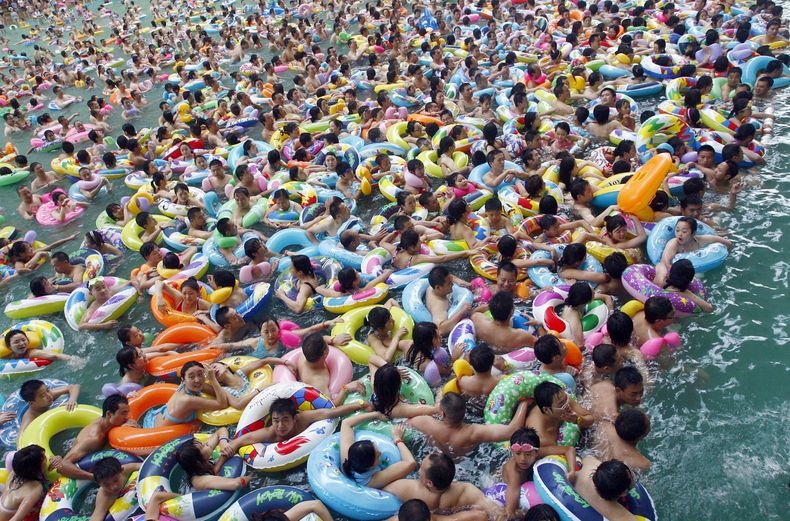
Swimming has long been a symbol of physical strength in China, yet outside the country's elite sports schools competitive swimming is not an option for ordinary Chinese who might want to take it up as a hobby. For most Chinese, pools are only a place to cool off, not to race. During the peak days of summer when the heat becomes unbearable, the pools explode into a riot of colors as thousands of people jump into it to escape the scorching heat. The popular slang expression used for going swimming is "boiling dumplings" because public pools are so crowded that all a person can do is stand on the spot.
Lack of swimming facilities is the main reason why pools are crowded in China, and because of this people cannot pursue swimming as a year-round hobby. “Many local governments cannot generate enough money from indoor pools to run them year-round”, said Zhang Yeduan, deputy head of the Hongkou Public Pool, Shanghai's largest.
But the number of facilities is increasing as incomes rise and privately run gyms with pools proliferate. Some of these pools are massive. The “Dead Sea of China” is a saltwater swimming pool located in Daying county, Sichuan province, inspired by the original Dead Sea in the Middle East. The pool covers an area of 30,000 square meters and accommodate up to 10,000 visitors at once. Another swimming pool in the Yao Stink district is able to accommodate a staggering 230,000 swimmers at one time.
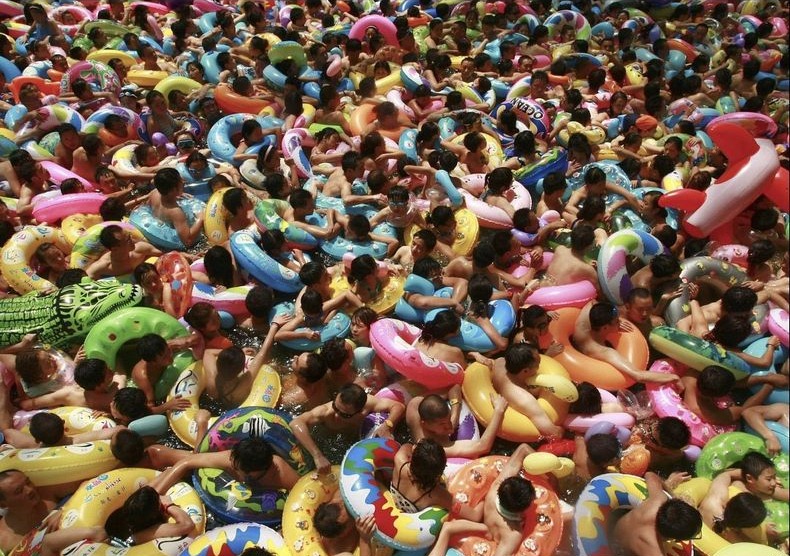
A gigantic breakfast bowl of human soup.
Do these pictures make you nauseate? It should. According to China’s Health Ministry report announced last year, out of 5,639 public swimming pools tested in 24 Chinese provinces, 10 percent of the pools exceed the safe limit for urea levels. In case you don’t know, urea comes from urine.
Research also determined that the total percentage of bacteria in a swimming pool can reach 92.3 percent while the rate of coli bacteria can be as high as 96.9 percent. The consequences of this can be fatal. In 2008, one man died and 3,158 swimmers critically poisoned when they swallowed the pool's water which was laced with the urine and fecal matter of 47,000 swimmers in the gigantic Mao Mao Municipal Pool in Beijing.
A toxicologist noted after taking a sample of the water that urine and fecal matter consisted of nearly 90% of the mix.


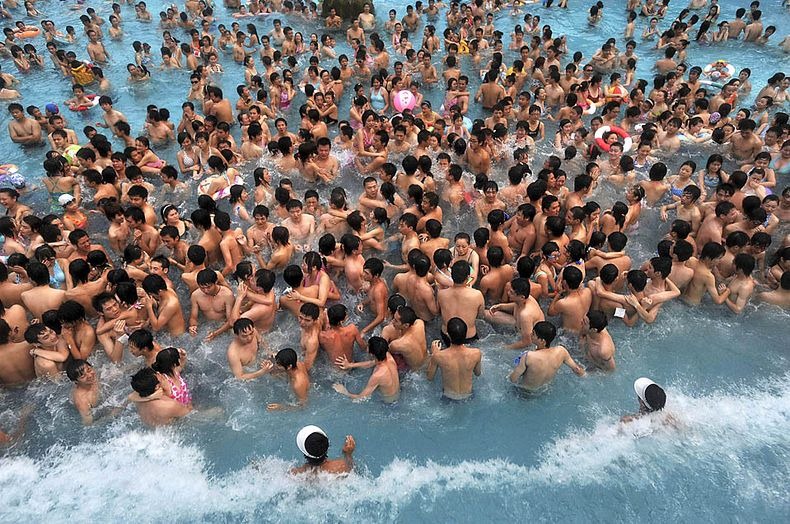
Crowded pools are also common in Japan. National Geographic photographer Michael Yamashita, who captured pictures of a typical summer day at one of the largest waterpark, the Tokyo Summerland, told My Modern Met:
Yeah, right!
Keep this in mind: if you are visiting China or Japan, stay out of public pools.


Source
READ MORE»
Lack of swimming facilities is the main reason why pools are crowded in China, and because of this people cannot pursue swimming as a year-round hobby. “Many local governments cannot generate enough money from indoor pools to run them year-round”, said Zhang Yeduan, deputy head of the Hongkou Public Pool, Shanghai's largest.
But the number of facilities is increasing as incomes rise and privately run gyms with pools proliferate. Some of these pools are massive. The “Dead Sea of China” is a saltwater swimming pool located in Daying county, Sichuan province, inspired by the original Dead Sea in the Middle East. The pool covers an area of 30,000 square meters and accommodate up to 10,000 visitors at once. Another swimming pool in the Yao Stink district is able to accommodate a staggering 230,000 swimmers at one time.
A gigantic breakfast bowl of human soup.
Do these pictures make you nauseate? It should. According to China’s Health Ministry report announced last year, out of 5,639 public swimming pools tested in 24 Chinese provinces, 10 percent of the pools exceed the safe limit for urea levels. In case you don’t know, urea comes from urine.
Research also determined that the total percentage of bacteria in a swimming pool can reach 92.3 percent while the rate of coli bacteria can be as high as 96.9 percent. The consequences of this can be fatal. In 2008, one man died and 3,158 swimmers critically poisoned when they swallowed the pool's water which was laced with the urine and fecal matter of 47,000 swimmers in the gigantic Mao Mao Municipal Pool in Beijing.
A toxicologist noted after taking a sample of the water that urine and fecal matter consisted of nearly 90% of the mix.
Crowded pools are also common in Japan. National Geographic photographer Michael Yamashita, who captured pictures of a typical summer day at one of the largest waterpark, the Tokyo Summerland, told My Modern Met:
It seems a number of viewers are horrified, appalled, nauseated and generally grossed out by the sheer number of swimmers squeezed into these mega-pools.
There's no question that given the heat, humidity and population of Tokyo in the summer, the throngs at any swimming pool there are going to, by definition, test the limits of crowd control and sanitation. Japan, however, is prepared for this and manages to keep everyone happy and cool no matter how jam-packed the pool - by moving the water rather than the swimmers. While not exactly conducive to laps, giant wave pools surge with swells a meter or higher, drenching stationary bathers so they don’t need to swim to cool off. Other pools feature circular courses with a current that keeps everyone moving together in the same, very orderly, direction. And of course, Japanese people, by tradition and habit, are arguably the cleanest – not to mention the most cleanliness-conscious – in the world. The water in these pools is clean enough to drink!
Yeah, right!
Keep this in mind: if you are visiting China or Japan, stay out of public pools.
Source


