“Ancient trees are a living link to our past and they often provide a fragile constant in an ever-changing world. This is their story, but in equal measure it is also ours. Each tree has its own distinct shape and character which it carries through its lifetime.”
The following top 10 bizarre tree photos are both beautiful and awe-inspiring. A tree is indeed a beautiful thing. Who knew trees were as individual as people, but even more fun to climb.
When anything is rare in nature we tend to have a little more awe involved in our emotions. What bigger miracle is there than the birth of a new life, but it happens so frequently we take it for granted. But creatures, organisms and animals that glow? Well, that is something to take notice of. Bioluminescent creatures make us oooh and ahhh because the fact that an organism can produce its own glowing light is fairly rare and especially cool to see. Believe it or not there are many more things on this earth than the firefly who create a glow we can appreciated. Here are some of the best pictures of Bioluminescent organisms you will find on the Internet.
Every year, various human activities and natural phenomena cause environmental disasters and substantial economic losses throughout the world. Despite this dark side, there’s something fascinating about the power of nature and its impact.
Don’t expect to find the very popular Aurora Borealis or red tides listed here. The goal of this list is to present some of the most interesting natural phenomena / hazards that occurred in 2011 and 2012, ones that are less known to the general public.
Criteria such as rarity and uniqueness were fundamental in determining the structure of this Top 10 list. Everybody heard about the 8.9 magnitude earthquake that struck Japan on March 11, 2011, or about the East African drought, so here are other very interesting phenomena (from as many different countries as possible):
10. Steaming Black Sea – Romania
Sun-warmed, humid soil can steam, so may a lake, sea or ocean if the air above it is sufficiently cold. “In the latter case, the phenomenon is commonly termed steam fog (if it occurs over fresh water) or sea smoke (if it occurs over saline water)”, according to P. M. Saunders from the Woods Hole Oceanographic Institution.
This spectacular picture was taken some months ago in Romania, and captures the incredibly beautiful sea smoke over the Black Sea. How Dan Cristian Mihailescu always happens to be in the right place at the right time with his camera amazes me.
9. Bizarre Sounds Coming from the Frozen Black Sea – Ukraine
If you ever wondered how a frozen sea sounds like, here’s your answer! It sounds like fingernails scratching against a blackboard. The video was shot off the coast of Odessa, Ukraine.
There’s a strophe in S. T. Coleridge’s narrative poem, “The Rime of the Ancient Mariner,” that perfectly captures the essence of this video: The ice was here, the ice was there / The ice was all around / It cracked and growled, and roared and howled / Like noises in a swound!
8. Spider Web Trees – Pakistan
An unexpected side-effect of the massive flooding that swamped one-fifth of Pakistan was that millions of spiders turned trees into cocoons. They crawled into trees to escape the rising flood waters.
The gigantic spider web found in Texas is an arachnophobe’s worst nightmare. It covered 200 yards!!! Despite the fact that spiders are cannibalistic and their webs are unconnected, specialists studied more than 240 specimens and identified 12 families of spiders in the huge web. There is little consensus about what sparked this once-in-a-lifetime phenomenon.
7. Fire Tornado – Brazil
A rare phenomenon known as a “fire tornado” has been caught on camera in Aracatuba, Brasil a couple of years ago. The lethal combination of high temperatures, strong winds, and wildfires caused the vortex of fire.
One of the most extreme fire tornadoes occurred in Japan. In 1923, the Great Kanto earthquake destroyed Tokyo, Yokohama and the surrounding areas. Subsequent firestorms caused tremendous destruction. The single greatest loss of life was caused by a huge fire whirl that killed 38,000 people in just fifteen minutes.
6. Cappuccino Shores – Cleveleys, UK
In December 2011, the seaside resort of Cleveleys, Lancashire was blanketed with sea foam (first picture). The second and the third pictures were shot in Cape Town, South Africa.
They may look like winter wonderlands, but the locals were anything but thrilled by the foam blown in off the Irish Sea.
According to specialists, the sea foam is made from fat molecules and proteins created by the breakdown of tiny sea creatures (phaeocystis). They form dense colonies, and the cells are held together by a gelatinous mass. The spume is formed when strong winds sweep up the decaying remains. The compounds act as foaming agents.
5. Snow In The Oldest Desert of the World – Desert of Namibia, Africa
Snow in the dry lands of Namibia is not unheard of, but it is a rare event. Statistics show that snow blankets the Namib Desert every ten years.
The rare June snow of 2011 fell during the day, from 11 o’clock in the morning until the afternoon. Meteorologists said the lowest temperature recorded by weather stations on that day was -7, in the town of Otjozondjupa, one of Namibia’s thirteen regions. Having endured arid conditions for over 50 million years, the Namib Desert is considered by specialists the world’s oldest desert.
4. Maelstrom Near The Port Of Oarai – Japan
An incredibly vast whirlpool appeared off the east coast of Japan after the tsunami hit the country. The vortex near the port of Oarai lasted several hours and happened “because of the interaction between rushing water and the geology of the coastline and seafloor,” said Ruth Ludwin of foxnews.com. Maelstroms are a common feature of tsunamis.
Some of the most famous and powerful whirlpools are Moskstraumen (also known as the Lofoten Maelstrom), Saltstraumen, Corryvreckan and the Old Sow whirlpool. Notable writers like Edgar Allan Poe, Jules Verne and Herman Melville described the Lofoten Maelstrom in their writings.
3. Dramatic Waterspouts – Australia
Four tornadic waterspouts were captured on camera off Australia’s coast in May 2011. The very interesting natural phenomenon created quite a stir with the locals, some of whom had lived in the region for over 45 years and had never seen a waterspout. The four dramatic waterspouts reached heights of nearly 2,000 feet.
Waterspouts are generally classified into two categories: tornadic and fair-weather waterspouts. Tornadic waterspouts begin as tornadoes over land and then move over a body of water. Their size varies from several feet to more than a mile in height. Waterspouts can be hundreds of feet wide.
2. Massive Dust Storm – Phoenix, USA
This incredible picture shows the huge dust storm that swallowed up Phoenix in 2011. The violent sandstorm – also known as haboob – originated in Tucson and appeared to be 50 miles wide in some areas. The dust cloud reached heights of 10,000 feet before arriving in Phoenix. It was caused by “the downdrafts of a collapsing thunderstorm complex generated by the Southwest monsoon,” wrote washingtonpost.com.
Sandstorms are a common meteorological phenomenon in Arizona, but locals and researchers said the storm of July 5th was unusually intense. The size of the storm, and the amount of dust it picked up, were extremely unusual.
1. Volcanic Ash Blankets Lake Nahuel Huapi – Argentina
The violent eruption of the Puyehue volcano – near the city of Osorno, southern Chile – caused something quite incredible in Argentina. Northeasterly winds blew the ash over neighboring Argentina, and some parts of Lake Nahuel Huapi were covered by a thick layer of volcanic ash. Unlike the ash that remains after burning wood or other materials, volcanic ash is made of glass and rock particles, so it’s very abrasive and hard. To make matters worse, it doesn’t even dissolve in water.
With a depth of 1,394 feet and a surface of 529 km2, Nahuel Huapi is Argentina’s deepest and largest clear water lake. The lake stretches 100 km along the Chilean border. I’m wondering if Nahuelito, a monster reported to live in this lake, is still ‘alive’ after this disaster…
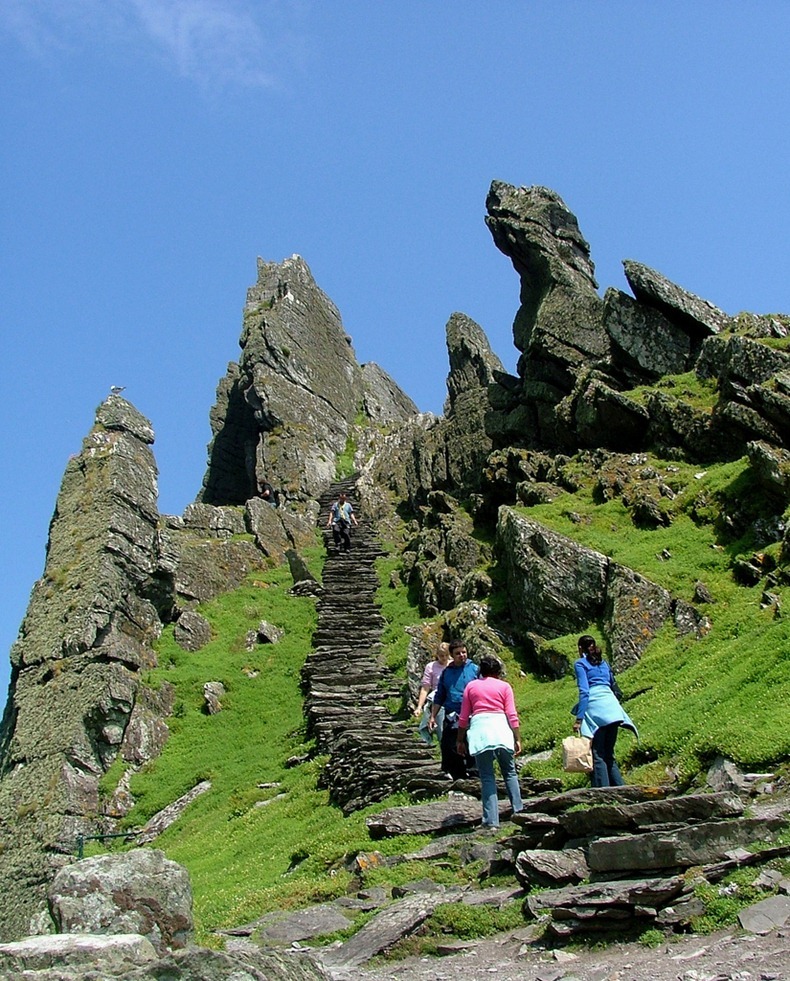
Skellig Michael, which means Michael's rock in Irish language, also known as Great Skellig, is a steep rocky island in the Atlantic Ocean 12 km off the coast of south-west Ireland. Perched high at the summit of a 230-metre-high rock is an ancient monastery probably founded during the 7th century. For 600 years the island was a centre of monastic life for Irish Christian monks. The monks lived in stone 'beehive' huts perched above nearly vertical cliff walls totally cut-off from the rest of the world by vast expanse of water, except for the occasional Viking invaders who raided the monastery from time to time.
Skellig Michael is an outstanding example of an early religious settlement deliberately sited on a pyramidal rock in the ocean, preserved because of a remarkable environment. The very spartan conditions inside the monastery illustrate the ascetic lifestyle practiced by early Irish Christians. Because of the extreme remoteness of Skellig Michael, the island has until recently discouraged visitors. This kept the site exceptionally well preserved.
Skellig Michael was occupied continuously until the later 12th century, when a general climatic deterioration led to increased storms in the seas around the island and forced the community to move to the mainland. However, a monastic presence was maintained and the buildings were kept in repair until the 16th century. Although monastery no longer existed, it continued to be a place of pilgrimage. Large numbers of pilgrims came and performed the way of the Cross from the Landing place up to the monastery. Skellig Michael also became a place for young couples to marry during lent, a time when marriage could not take place on the mainland but was permitted on the island.
Around 1826 the island was passed to the Corporation for Preserving and Improving the Port of Dublin (later to become the Commissioners of Irish Lights), who built two lighthouses on the Atlantic side, one of which is still in use today.
Skellig Michael in its entirety became a World Heritage Site in 1996.
Sea birds are abundant on Skellig Michael – the Guillemots, Puffins, Razorbills, Gannets, Fulmar and Kittiwakes. The whole Island turns white in the summer months from the vast number of birds nesting there.
The Twelve Apostles is a collection of limestone stacks off the shore of the Port Campbell National Park, by the Great Ocean Road in Victoria, Australia. Their proximity to one another has made the site a popular tourist attraction.
The Apostles are a collection of miocene limestone rock stacks jutting from the water in Port Campbell National Park, between Princetown and Peterborough on the Great Ocean Road. Tourism activities (including helicopter tours) are conducted from a visitor centre, situated on the inland side of the Great Ocean Road; with parking and viewing areas. Parks Victoria classifies the structure as nationally significant, with the area being one of Victoria’s major tourist features; attracting approximately two million visitors a year.
The Apostles were formed by erosion: the harsh weather conditions from the Southern Ocean gradually eroded the soft limestone to form caves in the cliffs, which then became arches, which in turn collapsed; leaving rock stacks up to 45 metres (148 ft) high. The site was known as the Sow and Piglets until 1922; after which it was renamed to The Apostles for tourism purposes. The formation eventually became known as the Twelve Apostles, despite only ever having nine stacks.
The stacks are susceptible to further erosion from the waves. On 3 July 2005, a 50 metre tall stack collapsed, leaving eight remaining. The rate of erosion at the base of the limestone pillars is approximately 2 cm per year. Due to wave action eroding the cliff face existing headlands are expected to become new limestone stacks in the future.