Fire Down Below, Centralia, Pennsylvania

Centralia is a small town located in Columbia County, Pennsylvania, in the very heart of Anthracite country. In May 1962, a fire started in a carelessly disposed trash incineration in an open pit mine near the town. The fire crawled along the coal-rich deposits far from the miner's pick to ignite a large coal vein running under the town.

The flames on the surface were successfully extinguished, but unbeknownst to the fire fighters, the coal continued to burn underground. Over the following weeks it rapidly migrated into the surrounding coal mines and beneath the town, venting hot and poisonous gases up into town, through the basements of homes and businesses. For the next two decades, workers battled the fire, flushing the mines with water and fly ash, excavated the burning material and dug trenches, backfilled, drilling again and again in an attempt to find the boundaries of the fire and plan to put the fire out or at least contain it.

All efforts failed to contain the fire. By the early 1980s the fire had affected approximately 200 acres and homes had to be abandoned as carbon monoxide levels reached life threatening levels.


The fire, smoke, fumes and toxic gases that came up through the back yards, basements and streets of Centralia literally ripped the town apart. The town had an original population of 1100 residents, which dwindled to a dozen in 2005. Most of the homes were abandoned and residents were relocated over the years with grants from the federal government although some refused to be bought out and some still remain in the town.

In its prime, Centralia was a vibrant community with five hotels, seven churches, nineteen general stores, two jewelry stores, and about twenty-six saloons. Today Centralia is a ghost town with only a few remaining residents. Unoccupied homes and buildings were demolished, and large portions of the town are being reclaimed by nature.

The fire still burns today beneath about four hundred acres of surface land, and it’s still growing. There is enough coal underground to feed the fire for up to two hundred and fifty years, but it may burn itself out in as few as one hundred years.


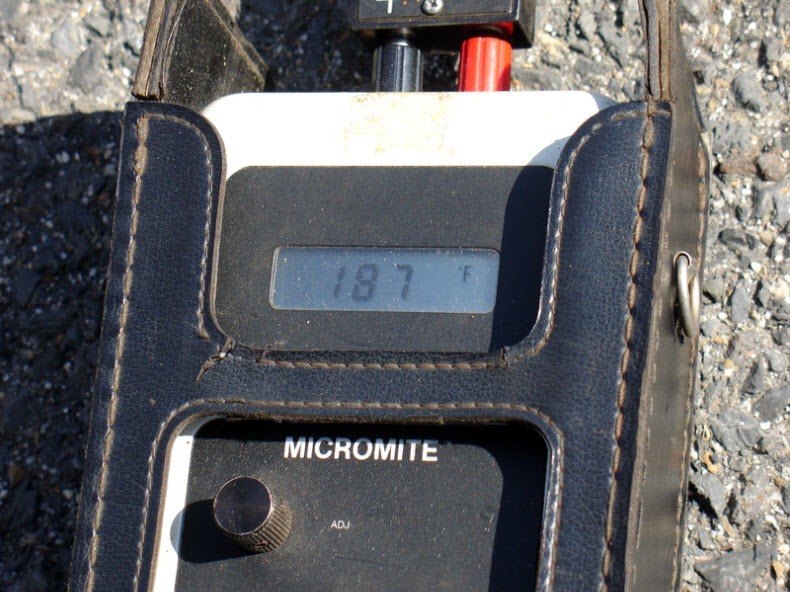
Thermocouple reading of a temperature probe approximately 10 feet down into a survey hole in Centralia, Pennsylvania.


Aerial view of Centralia.


Capped bore holes in the streets that were used to monitor the temperatures below.


Antique picture of Centralia, before the fire. Date unknown.


Antique picture of Centralia, before the fire. Date unknown


Source
READ MORE»

20,000 Year-Old 'Vimana' Aircraft Landing Gear Discovered?

For many years certain researchers in India and Asia have tried to convince Western skeptics that the so-called religious texts of the Vedas are really descriptive history. Lending credence to their claims are various artifacts found over the years and detailed descriptions of the vimana aircraft engineering and construction.

The incredible discovery during the 1990s of the remains of an ancient city in northern India that was still highly radioactive sent some archaeologists scrambling to the site.

And then, a very strange artifact, the Wedge of Aiud,first unearthed in 1973, was given another look: a machined piece of metal made of an aluminum alloy. Originally thought to be about 400 years old, new tests have determined it's from 18,000 B.C.E., from the Pleistocene Era, nearly 20,000 years before aluminum's discovery in modern times.

Odder still, some experts believe the artifact may be part of an aircraft landing gear…possibly from one of the ancient Indian vimana flying machines described in the Veda texts.


The lost super city-states
Evidence that has accumulated during the past few centuries adds credence to the idea that super city-states arose sometime towards the end of the last Ice Age. The best evidence for the location of some of the cities—that may have spanned the globe—lies in northern India and southern Pakistan, and a desolate stretch of the Mongolian Gobi desert northwest of China.

Those advanced cultures are said to have possessed a very high technology, equal in some respects to that of the 21st Century.

Ancient texts refer to towering buildings, various types of aircraft, a high level of science and engineering, and even a weapon that today's physicists believe was first used in the closing days of World War Two: the atomic bomb.

It may be that the advanced cultures wiped themselves out by engaging in a limited nuclear war. Evidence gleaned over the past few decades does point in that direction.

Perhaps after a series of devastating attacks, the remaining network of advanced cultures collapsed succumbing to the ravages of economic depression, displacement, and disease.

If so, the vestiges of one or more of those cultures may have served to fuel the legend of the great city of Atlantis that appears in Plato's 360 B.C.E. Dialogues, Timaeus and Critias.

After the collapse, the remainder of Mankind fell into barbarism and knowledge of the fantastic technology devolved into myth. This viewpoint is supported by the fact that some of the earliest cave paintings reveal a greater level of sophistication than those that were created hundreds of years later.

The human race regressed and the once great glories of the super-cities occulted by the swirling mists of time.


Illustration of a vimana by David H. Childress

The ancient flying machines
According to the revered Indian Vedas Sanskrit writings, vimanas were flying machines. The word vimana is still used today in the modern Indian language to refer to aircraft.

While most vimanas were used for transportation through the atmosphere, some were described as being used to travel into space while others were a form of limited submarine.

Just like modern aircraft, the vimanas had various configurations and sizes depending on what they were designed to accomplish. Some had two engines, like the agnihotra-vimana; others, like the gaja-vimana, had more. In all there may have been as many as a dozen different types of vimanas all designed for different purposes. Most of them flew.


Atomic attack...20,000 years ago
Traces of an ancient atomic war between advanced and powerful city-states still linger in northern India-Pakistan and parts of the great Mongolian Gobi Desert. Scientists have known for many years about the expanse of vitrified sand that covers a region of the Gobi. The fused sand, greenish in color, can only be created by exposure to intense heat. Geologists theorize that the sand became vitrified by exposure to volcanic action; astronomers claim a large meteor might have done it; physicists wonder if it was caused by an atomic explosion.

Those three incidents are the only things that could account for the region of vitrified sand that lies in the lonely stretches of the arid land.

But volcanic origins are out as no volcanoes exist in the region.

No evidence exists of a crater or meteoric residue that would be found if a rock from space slammed into the desert scarring the terrain and searing the sand.

The process of elimination leaves only an atomic blast to account for the strange condition of the sand—a glassified region where nothing grows.


Supporting the atomic theory is the fact that some of the area has a higher level of background radiation than similar terrain outside the affected area. It's almost as if something once stood in that deserted region and was vaporized by a blast like the explosions that destroyed Hiroshima and Nagasaki.

Another find that supports the existence of a technologicaly advanced city-state about 20,000 years ago was the stunning discovery of the remains of an ancient city in the northwestern state of Rajasthan, India. The site was found when construction began for a new housing development.


What astonished archaeologists eventually determined was the remains of charred and partially melted buildings and radioactive skeletons were covered by a thick layer of ash—later confirmed to be radioactive. The ash covered a three-mile square area.

Other research shows that several major city states existed and at least two or more were at war with each other. While much attention has been focused on the northern Indian city, little has been spent investigating the remains of the ancient atomic blast in the Gobi.

The ancient region is thought by some Indian university professors to be a forerunner of the more modern Matsya, another ancient state of the Vedic civilization. The Matsyan culture is believed to be associated with an earlier state called Jaipur.

Another Indian text, the Mahabharata, considered by some scholars to present more fact than myth, contain passages that describe in detail the atomic attack on the city that the construction crew accidentally uncovered:

"A single projectile charged with all the power in the Universe…An incandescent column of smoke and flame as bright as 10,000 suns, rose in all its splendor…It was an unknown weapon, an iron thunderbolt, a gigantic messenger of death which reduced to ashes an entire race.

"The corpses were so burned as to be unrecognizable. Their hair and nails fell out, pottery broke without any apparent cause, and the birds turned white.

"After a few hours, all foodstuffs were infected. To escape from this fire, the soldiers threw themselves into the river."

The atomic conflagration described was every bit as horrific and deadly as the attack on the Japanese cities in August, 1945.

Although the text suggest delivery of a nuclear weapon by a missile, ancient Indian writings also describe—in amazing detail—the flying machines called vimanas. The texts outline the vimana's flight characteristics, construction, powerplant ( a jet-rocket hybrid powered by plasma mercury engines), and engineering specifications.

The mysterious Wedge of Aiud may have come from a vimana.


Enigma of the 20,000 year-old Vimana landing gear: the aluminum 'Wedge of Aiud'
Near the picturesque banks of the Mures River located a little more than a mile east of the small city of Aiud, Romania, a bizarre artifact was unearthed dubbed the Wedge of Aiud.

Researcher Boczor Iosif investigated the find and reported that the wedge was discovered beneath 35 feet of sand. Two mastodon bones were reportedly also dug up near the wedge.

A report by Lars Fischinger states that he and an associate, Dr. Niederkorn, analyzed the wedge at the Institute for Research and Design. They determined the artifact was a metal alloy composed of 12 different metals. Their report lists aluminum making up about 89 percent of the object, the rest they listed as: "6.2% copper / silicon 2.84% / 1.81% zinc / 0.41% lead / tin 0.33% / 0.2% zirconium / 0.11% cadmium / 0.0024% / nickel / 0 , 0023% cobalt / bismuth 0.0003% / 0.0002% silver and traces of Galium."

The test results puzzled the two researchers as aluminum wasn't discovered until the early 1800s. Fischinger notes that commercial production of aluminum requires smelting the ore at temperatures up to 1,000 degrees Fahrenheit.

Initially, the object was thought to be about 400 years old. That changed dramatically when they carefully analyzed the amount of oxidation covering the wedge. They readjusted the age backwards by thousands of years.

It's now estimated the Wedge of Aiud may date back to 18,000 B.C.E. That date coincides with the age of the vimanas.

After the test results were analyzed, the wedge was sent to the Museum of History in Transylvania, Romania where it sat on a shelf, undisturbed, for two decades.


Florian Gheorghita, holding the Wedge of Aiud

Finally, in 1995, another Romanian researcher, Florian Gheorghita, came across the artifact in the museum basement. The wedge was tested again. This time in two different laboratories: the Archeological Institute of Cluj-Napoca and an independent Swiss lab. The tests confirmed the results arrived at by Fischinger and Niederkorn.

Gheorghita wrote in the publication Ancient Skies that he asked an aircraft engineer to study the artifact. The engineer noted the configuration and the hole drilled in the wedge and stated that a pattern of abrasions and scratches on the metal led him to believe it was part of an aircraft landing gear.

A sketch was made to illustrate the configuration.


Sketch by Florian Gheorghita of the artifact in use


Sketch by Florian Gheorghita of the artifact itself

Since the ancient city-states had advanced transportation—perhaps even space vehicles—it was easy to transnavigate the world just as modern aircraft do today.

The engineering and metallurgical evidence strongly supports the theory that the mysterious Wedge of Aiud is a piece of a landing gear that fell off a vimana some 20,000 years ago and lay unretrieved for millennia after the sandy banks of the Mures River swallowed it up.

Maybe someday the earth will reveal more of its secrets, hopefully an entire vimana—intact.


Source

READ MORE»

Top 10 Beautiful Aquatic Lifeforms that Can Kill You

All that glitters is not gold. They can be carnivorous, they can be venomous, and they kill. So think twice before getting attracted to a pretty creature you just saw at the beach.


10. Australian Box Jellyfish

Box jellyfish most visibly differ from the “true” jellyfish in that their umbrellas are cubic, rather than domed or crown-shaped. Box jellyfish can not only move more rapidly than other jellyfish due to their slightly different structure but are also significantly more beautiful as they are almost transparent. You dive and see this magnificent beauty (or even if you don’t see) then don’t dare to touch it because the box jellyfish has been called “the world’s most venomous creature”, though only a few species in the class have been confirmed to be involved in human deaths. It is a sea wasp, the Australian box jellyfish can have up to sixty tentacles, each 15-foot long and with enough venom to kill 60 people.


9. Pfeffer’s flamboyant cuttlefish

It is a small beautiful 3.1 inch (8 centimeter) aquatic organism exhibiting radiant charm and velvety appearance. The dorsal surface of its cuttlebone is yellowish and evenly convex. The texture throughout is smooth, lacking bumps or pustules making it one of the most beautiful life forms in marine. It occurrs in tropical Indo-Pacific waters off northern Australia and southern New Guinea. Don’t try to cuddle this cuttlefish. Though charming and colorful, this aptly named fish’s displays are meant as a warning. Although they rarely encounter humans, its poison is considered extremely toxic and can be as lethal as the poison of the blue-ringed octopus.


8. Bottlenose Dolphin

This cannot be right. These guys save humans. Every other year or so, some diver or something gets lost out at sea, these guys bring them home. Dolphins have been compared to humans on a number of fronts. They are intelligent, communicate with each other, have the ability to learn, do tricks, play jokes, and can almost use their fins as hands. What’s not to love? Some people even believe they have special healing powers. Swimming with dolphins can be a therapeutic and enlightening experience. It may be their eyes, their smiling face, their playful nature or their intelligence, but dolphins have won their way into our hearts. Dolphins can be violent. Not only have they been known to kill and maim their own young, they also kill porpoises and play with their dead carcass for no apparent reason other than its fun. Male dolphins particularly show aggression towards human males when there’s a female involved. Why? Sexual competition. They may also drown your wife while attempting to steal her away and mate with her. In 2002 CNN reported that an amorous dolphin was targeting swimmers in Weymouth, England. Swimmers were being warned to stay away from the dolphin because “When dolphins get sexually excited, they try to isolate a swimmer, normally female. They do this by circling around the individual and gradually move them away from the beach, boat or crowd of people.” When dolphins get sexually aroused, they become rough. The swimmer may not be able to escape from the 400 lbs animal and drown. And in 1994, a male Bottlenose off the coast of San Paolo, Brazil, that was noted to be fond of female human swimmers attacked a pair of human males that the dolphin apparently considered to be competition and killed one of them.


7. Stonefish

Known as the most venomous fish in the world, the stone fish lives on the bottom of the reefs, camouflaged as a rock. It lives above the Tropic of Capricorn but can be found in the Queensland Great Barrier Reef as well. It’s venom comes from the dorsal area, that is lined with 13 spines, causing shock, paralysis and tissue death depending on the severity of the sting. First aid consists of immobilizing the venom by bandaging the affected area then applying a hot compress. The pain is said to be so excruciating that it lead to amputating the affected limb.


6. Giant King Squid

Giant King Squid is categorized as the highest mollusks in the kingdom of the invertebrate. Its eyes resemble a human’s eyes. It has 10 arm-like tentacles and when it stretches out its body its length can extend to as long as 65 feet. People always confuse it with an octopus. Unlike Giant King Squid, the octopus only attacks people when it feels a threat from a human. On 25 March, 1941, the British ship immersed into the Atlantic Ocean. When 10 of the survivors from the ship were about to get caught of one lifeboat, all of a sudden the Giant King Squid emerged to the surface of the ocean. It stretched out its arm-like tentacles to capture two of the survivors’ bodies tightly while triggering them into the bottom of the sea. It was reported that the male Giant King Squid would occasionally eat the female squid after its fertilization.


5. Hagfish

A recently discovered ancient aquatic lifeform, known as hagfish is sometimes labelled as disgusting due to its slime producing capabilities. Hagfish average about half a metre. When captured and held e.g. by the tail, they secrete the microfibrous slime, which expands into a gelatinous and sticky goo when combined with water; if they remain captured, they can tie themselves in an overhand knot which works its way from the head to the tail of the animal, scraping off the slime as it goes and freeing them from their captor, as well as the slime. While marine worms on or near the sea floor are a major source of nutrition, hagfish can feed upon and often even enter and eviscerate the bodies of any injured creature much larger than themselves. They are known to devour their victims from the inside. Recently a few couple of cases have been noted when human deadbodies were found in sea shaped like a stocking without any mass. The predator was found to be hagfish.


4. Moral Eels

Moray eels mostly live in salt water. They can grow upto 4 meters in length. The body of Moray Eel generally patterned. Camouflage is also present inside the mouth. Their jaws are wide, framing a protruding snout. They possess large teeth, designed to tear flesh as opposed to holding or chewing. Morays hide from humans and would rather flee than fight. Morays are shy and secretive, and attack humans only in self-defense or mistaken identity (for example, a finger placed in a crevice where a moray resides may resemble a prey-item). Most attacks involve accidental bites during human-initiated interaction. Morays cannot see very well and rely mostly on their acute sense of smell.


3. Puffer Fish

These funny looking Puffer fish are the second most poisonous vertebrates on earth after the Golden Poisonous frog. The puffer’s skin and certain internal organs are highly toxic to humans. Deadly poison called Tetrodotoxin (TTX) is contained Puffer fish. Toxins are more powerful than cyanide resulted in difficulty in breathing on a person before leading to death. Still in some parts of Japan and Korea chef’s remove the poisonous part and meat allowing it to be served as meal.


2. Lionfish

A Lionfish is one of the venomous fish which looks beautiful yet dangerous. The Lion fish have long and separated spines and have a generally striped appearance red, green, navy green, brown, orange, yellow, black, maroon, or white. Divers should be extremely cautious and avoid contact with the venomous spikes of the Lionfish. Usually, Lionfish are not aggressive toward humans and will almost always keep their distance. In addition, their stings are not very deadly, but they are still very painful.


1. Blue Ringed Octopus

The blue ringed octopus is tiny and beautiful. Its amazing rings flash a rich fluorescent blue. An individual blue-ringed octopus tends to use its dermal chromatophore cells to camouflage itself until provoked, at which point it quickly changes color, becoming bright yellow with blue rings or lines. Should you run across this tiny vividly colored octopus, you may think to grab it to take home to your salt water tank. Grabbing it for your salt tank might be a deadly mistake. The blue-ringed octopus is 5 to 8 inches, but its venom is powerful enough to kill humans and there is no blue-ringed octopus anti-venom available. They pounce on their prey, paralyze them with venom and use their beaks to tear off pieces. They then suck out the flesh from the body. Once bitten, the fast acting poison leads to loss of sight, taste and touch immediately. Without quick treatment, the paralysis will cause asphyxial death because of respiratory paralysis.


Source

READ MORE»

Top 10 Vestigial Structures, The Most Controversial Human Organs

Vestigial structures were first described by Charles Darwin, as a prove of his evolutional theory, which represented the starting point of a completely new way of seeing life and human beings, as well as of an intense controversy that would last to this day. These vestigial structures were seen by Darwin as completely useless organs, though today’s science also labels as “vestigial” those structures that still serve minor, or secondary roles. Here are 10 most important body parts that are widely believed to be inherited from our primate ancestors:


1. The appendix

The appendix is a world famous vestigial structure of the human body. While the appendix of other mammals still has a function, ours remained unused and degraded from an apparently larger sized organ to the small one we posses today. Darwin promoted the idea that it may have served as a leaves digestion system in primates, while other scientists believe that it may still serve a purpose today, though no clear evidence was brought to sustain neither of the theories.


2. The tailbone

Our tailbone is a great prove of the evolutionary theory and thus, a highly controversial part of our body. While some claim that the coccyx does have a role, as a sustainer of the pelvic organs and as a connector for several muscles of the legs(thus being a sustainer of the creationist theory), others mention the surgeries of tailbone removal which had no effect upon the further life of the patients and even give the example of babies born with an extension of the tailbone under the shape of a small tail.


3. The male nipples

So, why do you think that men have nipples for? No reason at all would be the right answer. Men’s nipples are another example of human useless body parts, as they do not have any role in the functioning of a male’s organism. However, they do not have the same origin as the backbone. Actually, the breast tissue and the nipples were formed in an early evolutional stage of the fetus, when the sex of the future baby was not yet established.


4. The wisdom teeth


They are one of the most clearly vestigial structures of the human body. Sometimes, these teeth do not manage to grow at all and continue to remain in the jawbone for the entire life of the owner. They are clearly vestigial, as they are useless when eating. Humans usually do not chew by using these teeth, because they are too far back in our mouths. They are a mere prove that humans evolved from primates who owned much larger mouths and were able to use those teeth.


5. The third eyelid

The third eyelid or “the plica semilunaris” is a transparent membrane used for the protection of the eye and it is encountered most often at birds reptiles and fish, but some mammals have it too. What you probably did not know is that humans have vestigial third eyelids too. It is generally accepted that the small fold of tissue at the interior corner of the eye, which you might have noticed many times before is a now useless remaining of a transparent membrane we used to have in an early development stage.


6. The body hair and the goose bumps

What do we use our body hair for? Nothing at all, right? Most women depilate and they do not suffer because of losing that extra hair. Thus, body hair is one of the vestigial structures of humans which shows that we were once covered with fur. Moreover, our natural response to fear and cold is the so called “arrector pili”, or goose bumps which represent a reaction of a muscle in the skin, similar to that of other mammals, that fluff their fur so as to look more threatening , or to warm up, as the situation demands.


7. The tonsils

For many years, tonsils were considered totally useless and were removed without any second thought, if they got infected frequently. Today, however, we know that tonsils do have a role, as they stop bacteria from reaching our organism, as part of our immune system. This fact does not exclude them, though, from the list of vestigial organs of our body, as creationists consider. As I mentioned above, their opponents define vestigial structures as organs that lost their primary role, but may have kept however a secondary or minor role in the organism, thus including tonsils as well.


8. The thirteenth pair of ribs

Things are not clear here either. Because the thirteenth pair of ribs is present at apes we might assume that the 8 % of humans inherit this trait because they have a completely useless extra pair of ribs which at times may even cause them problems. However, since most people do not have this body part , we may infer that this is just an abnormality.


9. Ear muscles

The ear structure also shows evidence of a now useless ability. Most apes are capable of moving the ears so that they may hear better hearing and become aware of dangers. For humans, this ability became useless since long and the muscles responsible with moving the ears atrophied and are now ineffective. Some people are still able to move their ears, though. Can you?


10. The little toe

Here we are “attacking” one of the most controversial items on this list. Is the little toe useful or useless? After reading and reading, I could not reach any conclusion on this one, so you might want to clarify things for me if you can! Some people consider that the fifth toe is absolutely vital for our balance, while others believe that it is only one of the vestigial structures of our body, as it was used for climbing, swinging and grasping and it does not affect balance either, so we will probably (and sadly) lose it at some point in the future …


Source
READ MORE»

Top 10 Best Cheap Cars in the World

Everyone needs a car. Unfortunately, not everyone affords to buy an expensive one, but this is not a disaster since all the car manufacturers take into the consideration the average people, with limited budgets and produce tones of cars for them to choose from. Some are not as good a deal as they might look, and some are worth more money than you spent. In order to help you discover the real bargains, here’s a top of the 10 best cheap cars in the world.


1. Ford Fiesta

The less expensive car in the world which is also worth buying is the Ford Fiesta. It is not difficult to drive and the fuel consumption is very low. This is the reason why it is America’s most sold car. You should also consider buying the one with automatic transmission, which is also even more fuel efficient. Being very easy to drive as well, with fast responding controls, this is a perfect car for beginners. The price starts at 13.320$.


2. Honda Fit

Honda Fit is never missing from these kinds of tops. A real city car, it is small and practical. Fun to drive and economical, it also provides a large storage space, unexpected for this little car. Honda Fit is at the second generation, released in 2008. It is larger than the previous one, its interior height is also increased and the handling and ride are also improved. The price starts at 14.900$.


3. Chevrolet Cruze


The Cruse from General Motors is a really cool ride. It has not only an affordable price but also a great look and amazing features which really do not come with a small price usually. Launched in 2008 this is a family car, with accents on practicability and comfort, but also with a large interior and a spacious trunk. The quality materials and its performance rank the Chevrolet Cruze among the best affordable cars in the world.


4. Kya Soul Base

This is a stylish mini-wagon which comes not only with a cool exterior, but with interior features to match as well, such as the optional lighted stereo speakers which blink in the rhythm of your tune.It also includes air conditioning, power windows and locks, antilock brakes, and electronic stability control. Its biggest advantage is the large interior storage, while the disadvantages of Kya Soul are the narrow color choice and the lack of automatic transmission. Its price starts at 13,995$.


5. Ford Fiesta S Sedan

This nice little car is a great option if you are looking for a bargain. It is a four doors ride, featuring a 120 horsepower engine, power locks (very important on a car with no lock buttons on the doors) and electronic stability control. Also, it the fuel consumption is very low, and it is easy and enjoyable to drive it. This wheeled jewel is designed in Europe and it does not have the usual cheap-looking grey plastic exterior bits characteristic ford the base cars. At only 13, 995 $, one can easily ignore the small rear seat and the wheelbase of 98 inches only, and the other minors faults. Overall, this car is a great deal.


6. Nissan Cube

Nissan cube is a Mini MPV produced by Nissan for the Japanese market in 1998 and it is now sold all over the world. The third generation was not very popular in Europe, due to its boxiness. The second cheapest car from Nissan, even though it’s avant-garde style could have given a kick to the price. Moreover, it comes with decent basic equipments, such as air conditioning, CD player, power windows and locks, as well as antilock brakes. Its price starts at 14,750$.


7. Suzuki SX4

This car comes in two different models, each of them having their own attractive features. The first model is the ‘Crossover’ which is actually great in winters, when the snow makes your life hard,, while the little ‘Sportback ‘ which comes with a nice big rear wing. Though it doesn’t have all-wheel-drive, riding this supermini can be fun. It also has a specious interior so it may be a family car, but only if your family uses to travel light since the boot is really small. The price of 16,499$ is complety justified.


8. Nissan Versa

Nisan Versa is ranked and priced as a subcompact car, while it feels and looks as a pricier compact one. It is surprisingly spacious and comfortable inside, which makes it a real good choice for longer trips, if you have a very limited budget. It really seems as if you bought yourself a mid sized car, but with less gas consumption and with much more parking options. The standard package has only a few conveniences, but at a price which starts at 9,990$,


9. Mazda 2 Sport

This Mazda is nice outside and great inside. It is appreciated for the quality of its materials, as well as for the low emissions and fuel consumption. It s not roomier that it can be expected for a car of this size, but there is enough space for four adults to sit comfortable. It has an impressive list of standard equipment, such as: power windows, mirrors and locks, air conditioning and electronic stability control. It has what it takes to be an excellent choice, however, its price of 14, 795$ is a bit too high for such a small car, considering the fact that there are cheaper oneson the market, equally well equipped, or even better.


10. Scion xB

The Scion is considered the best and the biggest of all the compact boxed cars. It is not very cheap when it comes to fuel consumption, but its cool aspect, as well as its amazing storage spaces may help you forget this aspect. More important, it is a really safe car, as the 2010 Scion xB ranked first in an ‘Insurance Top for Highway Safety’ . Scion xB is fun in the town and great on highways as well. Priced at 16,000$, this might be an excellence choice for any family or single driver.


Source
READ MORE»